|
BALI: THE MAIN DESTINATION
|
Bali -only 5,632 square kilometers in size- in one of the smaller islands of Indonesian archipelago. From Singaraja at the north point to Nusa Dua at the southern point is only 95 Km long; while from Gilimanuk in the west to Seraya as the eastern point is only 145 Km long. Now almost three millions people inhabit in this small island and the most stay in the southern part. The capital of this island is Denpasar (the word “Denpasar” means “eastern market”) with around 600.000 inhabitants. Bali has its distinct culture, unique arts and ceremonies, friendly smiling people and scenic views. This is why Bali always be the main tourism destination.
The majority people of Bali profess Hindu. The impact of Balinese Hinduism on the everyday life of the inlanders makes itself felt not only in the form of countless temples spread throughout the island but also in the lively tradition of procession, ritual dances and festivities celebrated in temples. Bali’s culture is based on its unique form of Hinduism called “Hindu Bali”. Religion is the source of life and very essential to the identity of the Balinese and to their pattern of life.
Kings and princesses of Bali had taken important role on the growth and development of Bali’s culture. Their palace -in Bali called “puri”- are well known as cultural centres since early time up to the present day. In the puri, many aspects of Bali’s culture find its fertile soil for its development and growth. The forms of arts, dances, music, and handicrafts are based on the old Hindu epics of Mahabarata and Ramayana and also the local folklores.
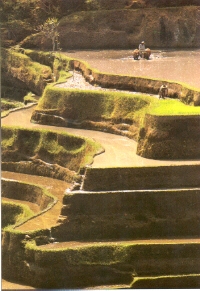
Immense volcanoes determine the shape of this island. The majestic Gunung Agung (3142 meters) rises in the east and its western flank houses The Besakih Temple, the mother temple, which was miraculously spared when the volcano last erupted in 1963. This peak is a part of chain mountains from west to east that divides this island into two big valleys: the northern valley which is an ideal area and climate for growing grapes, oranges and mangoes; and the southern valley, where farmers plant rice. Terraced rice field that providing beautiful natural scenery can be found everywhere around the southern part of Bali.
There are four lakes, many rivers and a lot of natural spring water from where farmers get water to irrigate their fields. These abundant natural sources on the other side also provide for the farmers more free time. They usually spend their time after planting rice in arts activities: music, dances, and other form of arts. This makes sense that every body are masters of any form of arts: painters, sculptors, woodcarvers, basket weavers, puppet and mask makers, dancers, musicians or daily offering makers. Daily offerings are placed at home, on the grounds, on the road, in the rice fields, and in he temple to placate the spirits. This make that the daily life of Balinese is full of offerings. It is in accordance with the name of this island “Bali”, a word from Sanscrete word “vali” that means “offering”.
BALI AND PLACES OF INTEREST
DENPASAR
Denpasar, situated in the southern part of Bali Island is the capital of Bali. The word “denpasar” is derived from the word “den” and “pasar” that literally means “the north of the market”. Denpasar is also the name of a king who in September 1906 heroically fought the Dutch. The population of Denpasar is around six hundred thousand inhabitants.
Denpasar has many community temples. One of them is Pura Jagatnatha. Jagatnatha means The King of The Universe; the other name of the almighty God. By the name we can know that this temple is dedicated to The Supreme God, Sang Hyang Widhi Wasa.
Towards the south of this temple we can find Bali Museum: an ethnographical museum. This museum offers fine selected collections of prehistoric and modern art representing Balinese life and culture from earliest time. The Dutch Government built this museum, firstly known as Gedong Area, in 1910.
Art Centre or Werdi Budaya must be another place of interest in Denpasar area. This complex was built in 1978 in traditional Balinese architecture and consists of three main buildings: Mandara Giri -a place for permanent art exhibitions-; Ardha Chandra: an open stage for performing Bali Art Festival activities; Ksirarnawa: the ground floor which is prepared for exhibition and art competitions.
During the visit to this city, we can also take a stop at local market, called Pasar Badung, and opened daily started at very early morning to late afternoon. Here we can find a great variety of agricultural products and daily needs: vegetables, fruits, spices, flowers, fishes, meats, dried goods and others.
SANUR BEACH
Sanur is a famous beach village since early times because of its beautiful scenery and atmosphere. The white sand covers the beach spreading from Bali Beach Hotel to the south, facing the Indian Ocean towards the east, so we always can see beautiful sunrise; and at the full moon this beach is always very romantic. As a tourist resort, many good hotels, restaurants, shops and other tourist activities can be found here. Sanur beach is also good for water sports such as wind surfing, boating, diving and canoeing.
KUTA BEACH
Previously this place was a lonely village on the road from Denpasar to Bukit; but now Kuta is a crowded tourist resort. Kuta beach has a very beautiful and large beach. As the beach facing to the west we can await for romantic and beautiful sunset here. The beach has white sand to the south but to the north the sand is grey. The waves are high and good for surfing; but since the current is sometimes irregular, it can be dangerous to swim in the sea. As a famous tourist destination, we can find many hotels from the luxurious class to the simplest ones that are usually called home stay, restaurants, art shops, art market, money changers, vehicles rentals and others.
NUSA DUA BEACH
Nusa dua Beach is a beach at the south of Bali, part of Bukit Peninsula. It is called Nusa Dua because there are two islands that united with Bali Island and then the coast around the island is called Nusa Dua Beach. This beach has white sand and the waves are quiet at the north and a bit bigger at the south. Formerly, this area was a coconut plantation with very low productivities, but now after some of the most beautiful and luxurious hotels are founded here, Nusa Dua had changed rapidly. This resort is known by numbers of five stars accommodations and its clean white beach, the clear water and gentle surf. So, it is also a good place for surfing, water sports activities and others.
BATUBULAN
Batubulan village is located at the route from Denpasar to Gianyar and is known as tourism object, because of stony statues, since tourist had visited Bali. Along the road of Batubulan, we can see many sandstone figures and statues making at workshops. Besides of these sandstones statues, everyday in Batubulan we can witness Barong Dance performance in the morning and Kecak and Fire Dance in the afternoon.
CELUK and MAS
The village of Celuk is noted for its silver and gold handicraft. As other arts centre village, the majority of the villagers earn their living by making and selling jewellery. The talents of making gold and silver works are handed down from one generation to another.
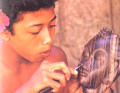
After Celuk village, we will find Mas village: the village of wood carvers. Here, many of Bali’s old masters still alive and their best works can be found in the arts galleries. We also can witness Balinese sculptors are demonstrating in making a woodcarving.
UBUD
Ubud is around 28 KM from Denpasar and known as Balinese painters community. It is said that the name of Ubud was derived from the word “ubad” that means “medicine” since so many people got their health back after asking for blessing at Campuhan River at Ubud area. Ubud, since the beginning of this century, is very famous for the artistic heritage. In 1936 was established Balinese Artist Organization named “Pita Maha” in Ubud under Cokorda Gde Agung Sukawati and some painters like Rudolf Bonnet and Walter Spies. Later, Pita Maha became a starting point for the developments and enrichment for Balinese traditional arts. Now we can find many different styles of painting, besides of traditional style, like: classical style, Batuan style, Young Artist or naïve style and modern style. They all make Ubud to be the artistic heart of Bali.
GUA GAJAH
Gua Gajah or Elephant Cave is an ancient hermitage complex dated from XI century. It is believed that this cave was a Buddhist monastery. The cave was discovered in 1923 and received its name from the archaeologists since at the above of the entrance of the cave there is a giant head with big ears and bulging eyes, which at the first glance is like an elephant. But according to a certain historical text, called Negara Kertagama, dated 1365 AD, said that there was a Buddhist hermitage called “Lwa Gajah” or “the water of elephant”-it is Petanu river now- in Bedahulu village.
The cave contains a four-armed Ganesha statue. This Ganesha statue is the guard of the cave. His first hand holds a broken ivory, as a symbol that he had left his demonic characters. The second hand holds an axe, symbolizing that he will always crush evil spirit; while the third hand holds a bowl, the symbol of knowledge. His fourth arm holds a rosary-like necklace, the symbol of an endless knowledge.
PURA TIRTA EMPUL
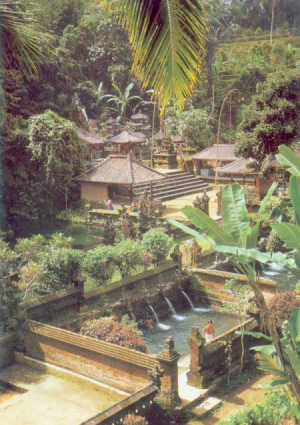
The name of this temple is taken from a water-spring in the yard of this temple. “Tirta” means holy water and “empul” means spring, so Tirta Empul gets the meaning of holy water that springs from the ground. For every Balinese this water is holy water. According to the legend, the water sprouts because of the arrow of God Indra during the fight with King Mayadanawa.God Indra used this spring water to sprinkle his dead soldiers and they would get alive again.
Pura Tirta Empul at Tampaksiring is still glorified by Balinese. This temple is considered as a symbol of justice and a place for purification. Balinese come to this temple to purify themselves with the holy protective water of spring. Pura Tirta Empul lies at the east of Tampaksiring village, in the midst of steep rice fields. Inside the temple we can see the holy part called “tirta” and the other part is ordinary water resource used to fill the fountains and swimming pool. If we look up we will see a complex of a beautiful presidential palace.
KINTAMANI
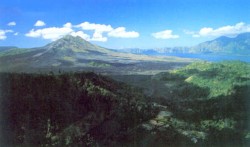
Kintamani and Penelokan village provide a breathtaking view to the active Batur volcano and Lake Batur. This lake is considered to be the ancient crater of the volcano. According to the data, in this century the volcano Batur erupted several times: 1917, 1926, 1963 causing 3.000 victims, 1974 and the last in September 1994 but did not cause any damage.
From Penelokan, meaning “the view point” we can enjoy a nice view of the volcano and the lake. At the other side of the lake, there is an ancient village named Trunyan that
is inhabited by people who called themselves “Bali Aga” or the original Balinese who have maintained many of their old ways. We can reach this village by boat crossing over the lake.
PURA KEHEN IN BANGLI
This pura or temple is an old temple, dated back from IX century, one of the most beautiful temples in Bali. This temple lies at the southern foot of Bangli hill, at the north east of the city of Bangli. There are three copper steles testify the importance and antiquity of the Kehen temple. One of the coppers, written in Sanscrete, dated 882 AD, says that Hyang Api, The god of Fire is worshipped in this temple. The name “Kehen” Temple means “the temple of fire” dedicated to Brahma, god of fire. Kehen Temple is constructed in eight levels: the first five are Jabaan or outer courtyards, the sixth and seventh terraces are Jaba tengah or middle court and the eighth level is Jeroan, the most sacred, where several shrines for gods and ancestors are found.
PURA GOA LAWAH
Pura Goa Lawah or Bat Cave Temple is one of the state temples of Klungkung Kingdom and most important temple on this island because of its proximity to the sea and to the mother temple Besakih. Built by Empu Kuturan in 1006 Caka firstly called Giha Lawah. This temple is a Dang Khayangan temple, the sitting place of Sang Hyang Naga Basuki and Bhatara Tengahing Segara. Named Goa lawah or Bat Cave Temple because of thousands fruit bats living inside the cave. The outermost courtyard of Goa Lawah Temple is the front beach. There are two giants dragons in the entrance of the temple symbolizing Anantaboga and Basuki snakes, which dwelled in the underground. Anantaboga means “never lack of foods”; while Basuki means “safe and sound”. All of us are long for Anantaboga and Basuki and we all want their blessings. That’s why this Goa Lawah Temple is devoted to these two good snakes.
PURI AGUNG KARANGASEM
The late Anak Agung Gede Jelantik built this Puri Agung or The Grand palace at the end of XIX Century and settled at Amlapura, the capital city of Karangasem regency. During XVIII and XIX century the Kingdom of Karangasem was the powerful kingdom of Bali, dominated Bali and Lombok Island. This Puri Agung is divided into three parts. The front part is called “bencingah” where
traditional attractions are usually held; and the inner part is “jaba tengah” the garden of the palace; and the innermost part is “jero” consists of the main building called Maskerdam or The Amsterdam Building where the king lives in. The name Amsterdam is used to commemorate the good relationship with the Dutch Government. The Royal Family lives in Bale London. There are still many other buildings around the palace with their own different purposes.
TIRTAGANGGA
Tirtagangga is known as the royal bathing pool. Derived from the word “thirta” and “gangga”. Tirtha means holy water, while gangga is the name of the sacred river in India. Thus, Tirtagangga means the holy water from Ganges. Formerly the kings of Karangasem used to come here for swimming, for refreshing and for contemplating.
This spring fed pool were built in 1948 by the king Anak Agung Anglurah Ketut Karangasem, is a combination of western, Chinese and Balinese architecture. The pool consists of three main parts: the lowest part has two pools and water tower, the middle part has cleaner pool, and the highest part is reserved for the royal family.
TENGANAN
Tenganan is an ancient Balinese village. In many aspects they still maintain old customs and old ways of life of pre-Hindu times. Etymologically, Tenganan comes from word “ngatengahang” which means “go to hinterland” and according to old documents written on old copper plates in the year 1040 AD, Mpu Kuturan, a holy priest, leaded the people of Tenganan move inland to avoid the sea which destroy their previous village. Since now the people of Tenganan believes that originally came from coastal village then moving inland.
A wall like an old castle surrounds Tenganan village and the main strait is 30 meters wide with communal buildings in the middle of the strait like meeting halls, granaries, ritual buildings etc. Tenganan people produce the three famous handicrafts: basket ware made from ata plant, writing on lontar palm leaves, and the very famous gringsing clothes.
BESAKIH, THE MOTHER TEMPLE
This mother temple of Besakih is the biggest, the most sacred and important temple of Bali. This temple is perched high on the slope of Mount Agung at 1,000 meters above sea level. According to the writing inscription Dang Hyang Markandeya, a holy priest, leaded the first enlargement on this temple. During this occasion, he buried five kinds of metal called “panca datu” namely: gold, silver, iron, bronze and precious stone to be the holy relics of the temple. The name “Besakih” is also still related to the construction of the temple. Derived from word “basuki” which means “safe, sound and prosperous”, Besakih got the name because Rsi Markandeya and his followers got safe and succeed at the beginning of the building of the temple after burying the panca datu.
Besakih Temple consists of many different temples and 18 ancestral temples or Pura Pedharman. To the Balinese a visit to the temple sanctuaries is a special pilgrimage. Firstly they will go to their ancestral temple to pray there and then to Pura Penataran Agung, to pray before the lotus throne (Padmasana Tiga) to honour Siwa, Brahma and Wisnu, the Hindu’s Trinity.
KLUNGKUNG - KERTAGOSA - BALE KAMBANG
Klungkung city or Semarapura was the ancient capital city of Bali from the year 1478 till 1908 AD. The name “Semarapura” means “the city of love”. Formerly Klungkung was a powerful kingdom, governing a realm that extends as far as Java, Bali, Lombok and Sumbawa, until The Dutch invaded and razed this kingdom to the ground. All that remains now are the great gate and garden, and two pavilions with magnificently painted ceilings: Kerta Gosa, the hall of justice and Bale Kambang, the floating pavilion.
Kerta Gosa or Hall of Justice built in 1686 AD during the reign of Ida I Dewa Agung Jambe. In former times was used as audience hall, where the king greeted his guests and invited them for a cocktail party. After The Dutch invasion, this building was used as hall of justice. Any social or traditional cases that cannot be solved in village levels will be brought here before the King as supreme judge.
Behind Kerta Gosa we can find Bale Kambang, the floating pavilion. Formerly this floating pavilion was used for palace’s head quarters and sometimes for the royal family’s tooth filling ceremony. Called floating pavilion because of the artificial pond surrounds, as if this pavilion floats in the pond. The beautiful classical paintings on the ceilings are the best of this style until now. They tell the story of Buddhist King, Sutasoma, who defeated all his enemies through passive resistance.
ULUWATU TEMPLE
Located on the very steep abyss and a headland towering cliff, Uluwatu Temple has a breathtaking site. The name “Uluwatu” comes from “ulu” meaning head and “watu” meaning rock, so Uluwatu means “the headland of rock”. The architect priest Mpu Kuturan built this temple in XI Century as one of august temples of the island. It is also believed that Dang Hyang Dwijendra ascended to heaven or “ngeluhur” here, so people gradually called this temple Pura Luhur Uluwatu. Uluwatu Temple, one of the six most important temples of Bali, dedicated to God Siwa. It has a breathtaking view to Indian Ocean and on clear day, the ocean below looks like a marine aquarium with tuna fishes and sea turtles. Here also lives small colony of naughty monkeys. Last but not least, this temple also provides a magical sunset.
PURA TAMAN AYUN
Pura or Temple Taman Ayun is a royal family temple of Mengwi, built on 1634 AD by the king of Mengwi, Cokorda Sakti Blambangan. The name of the temple’ “Taman Ayun” means “a beautiful park”. An artificial pond surrounds this temple as if Gods and holy ancestors of the king were relaxed in a floating palace. The pond is decorated with different kind of lotus flowers and also much kind of fishes lives here.
This temple is separated into three courtyards. The outermost courtyard is called Jaba and consists of Wantilan, an open stage theatre, Bale Bengong or gazebo, special temple for honouring Balinese healers or balian. The inner courtyard is called Jaba Tengah and specialized for preparing offerings and for ritual dancers, with three important buildings: Bale Kulkul, Bale Pegat and Kori Agung. Bale Kulkul is used for keeping the wooden bell or kulkul. Bale Pegat is symbolizing the severance of secular and spiritual realm. Everytime we pass this Bale Pegat, we have to leave behind our earthly problems and entering sacred territory. Kori Agung is the main entrance to the most sacred area. The innermost courtyard is called Jeroan, where most religious ceremonies are held. There are many shrines can be found here.
BEDUGUL
This mountain resort lies over 1,000 meters above sea level, is known as a recreational place. There are some optional places that are worth visiting around Bedugul. Pasar Candi Kuning or Candi Kuning Market is a local fruit, flower, spices and vegetables market. Kebun Raya or Bali’s Botanical garden, set aside of the large tropical rain forest in the foot hill of Bukit Tapat, has more than 650 species of trees and 459 species of orchids, can be another choice for relaxation and refreshment. The, Ulun Danu Beratan Temple, lies by the edge of Beratan Lake, the second largest lake in Bali. Ulun Danu Temple was built by the king of Mengwi in 1633 as the north point of his kingdom and dedicated to Dewi Danu, the Goddess of water.
TANAH LOT TEMPLE
Tanah Lot Temple is one of Bali’s most important sea temples. This temple is built on a huge rock, which is surrounded by the sea, on sixteenth century by the last holy priest who came to Bali from Java: Dang Hyang Nirartha. On his journey surrounded Bali, he passed by this place and spent the night on this huge rock. There he got a spiritual contact with heavenly spirit and by the following day he asked the local people to build a temple on the rock. This temple is called Tanah Lot, which means “a piece of land on the sea” because a part of that rock is covered by soil so plants can grow. The temple is dedicated to God Baruna, the God of Sea. At the base of this rocky island can be found some poisonous sea snakes, and it is believed that those snakes are belong to God of this temple, to be the guard of the temple from evil spirit and intruders. The best time to visit this temple is in the late afternoon when we can also wait for dramatic and unforgettable sunset.
General
Information l Balinese Dances l Travel
Tips l Picture Gallery
l Exchange rate l Places
of interest
|